Blogs

Articles (11)


The Future of Jewelry Customization: Where AI Meets Craftsmanship
May 11, 2026
Imagine describing your dream ring in plain English or sketching it on a napkin - and watching it come to life as a photorealistic 3D model in seconds. Then refining every detail until it's perfect. Then having it manufactured exactly as you envisioned. That’s not the future. That’s what we built for **Illuma Diamonds**. At **Peninsular Research Operation**, we created an AI-powered jewelry design platform that’s transforming how jewelry gets customized - whether you're a customer designing from home, working with a jeweler in-store, or a designer serving clients. ## The Problem Everyone Feels ### For Customers You have a vision. Maybe it's inspired by a Pinterest board, a family heirloom, or something you sketched while daydreaming. But translating that vision into reality? That’s where things get frustrating. Traditional customization means: - Struggling to describe what you want in technical terms - Waiting days or weeks between design iterations - Never quite seeing your vision until it's physically made - Feeling disconnected from the creative process ### For Jewelry Businesses You want to offer true customization, but the process is challenging. Designers spend hours manually creating concept sketches. Customers struggle to communicate their ideas clearly. Multiple revision cycles slow down sales. Complex designs require expensive renders or physical prototypes. Converting custom orders into manufacturable specifications is labor-intensive. Both sides want the same thing: **A faster, clearer, more collaborative way to bring custom jewelry to life.** ## The Solution: AI That Understands Design Intent The platform we built for Illuma Diamonds transforms ideas into production-ready jewelry designs through three simple starting points. ### 1. Natural Language Design Customer types: > “Vintage-inspired engagement ring, oval diamond with hidden halo, Art Deco geometric details on the band, platinum.” The AI instantly generates multiple photorealistic 3D concepts - each interpreting the design brief differently while honoring the specified style, gemstone, and materials. No need to know technical jewelry terms. No CAD expertise required. Just describe what you want the way you'd describe it to a friend. ### 2. Sketch-to-Design Draw your idea - on paper, on a tablet, even with your finger on a touchscreen. The AI reads the sketch and understands: - Overall shape and proportions - Stone placement and size relationships - Band design elements - Setting style intentions It then transforms that rough sketch into refined, photorealistic renders - keeping the spirit of your original concept while adding professional polish. Perfect for: - In-store consultations where customers sketch ideas with a jeweler - At-home exploration before visiting a store ### 3. Inspiration-Based Creation Upload a reference image - from Instagram, a magazine, or a photo of jewelry you love. Example: > “I love this necklace, but can we make it more modern with a different stone arrangement?” The AI analyzes the reference, extracts core design elements, and generates variations that blend the inspiration with your specific modifications. ## Interactive Refinement: Design at the Speed of Thought Here’s where the magic really happens. Once you see initial concepts, the conversation continues: - “Make the band thinner” - “Try a cushion cut instead” - “Add more vintage details” - “Show me this in rose gold” Every change renders instantly. You can: - Rotate the 3D model - Zoom into intricate details - See light reflections across facets - Explore multiple variations instantly ### In-Store Power For jewelers, this transforms consultations. Instead of saying: > “Let me sketch something and we’ll meet next week.” You’re designing together in real time. Customers leave with confidence, not questions. ### At-Home Freedom For customers exploring independently, the platform allows experimentation without pressure. You can: - Try bold ideas - Compare variations - Refine concepts freely - Build confidence before visiting a jeweler ## From Digital to Physical: Production-Ready Outputs Beautiful renders are just the beginning. Every approved design exports as: - GLB files for 3D printing - CAD-compatible formats for technical refinement - Detailed specifications for gemstone sourcing - Manufacturing notes capturing customization choices ### For Jewelers No more manual translation from customer concepts to production specs. What you design is what you manufacture - with technical precision built in. ### For Customers Confidence that what you see on screen is exactly what you'll receive. ## Why This Changes Everything ### For Customers #### True Creative Control You’re not picking from a catalog - you’re genuinely participating in design. #### Instant Gratification See your ideas come to life in seconds, not weeks. #### Informed Decisions Compare options easily and explore variations confidently. #### Emotional Connection When you help design your jewelry, it becomes deeply personal. ### For Jewelry Businesses #### Faster Sales Cycles Close custom orders in one meeting instead of three. #### Differentiation Offer an experience competitors can’t match. #### Higher Conversion Visualization reduces uncertainty and increases buyer confidence. #### Reduced Design Overhead AI handles concept generation so designers can focus on refinement. #### Scalable Customization Offer deep personalization without increasing operational complexity. ## Flexible Implementation: Your Business, Your Way The platform adapts to different business models and workflows. ### In-Store Experience Use it during consultations as a collaborative design tool where customers and jewelers co-create in real time. ### Online Self-Service Embed it into your website so customers can explore ideas independently before engaging with your team. ### Professional Designer Tool Use it internally for rapid prototyping and concept exploration before detailed CAD production. ### Hybrid Approach Allow customers to begin at home and finalize designs in-store with expert guidance. ## A Real-World Example: The Engagement Ring Journey ### Traditional Process - Week 1: Initial consultation - Week 2: Designer sketches - Week 3: Revisions - Week 4: CAD render review - Week 5: Final adjustments - Week 6+: Production begins ### With AI-Powered Design - Session 1: Customer uploads inspiration images and sketches concepts - Minutes later: Multiple photorealistic 3D concepts generated - 30 minutes later: Final design approved collaboratively - Same day: Production-ready files exported The result: - Weeks compressed into hours - Uncertainty replaced with confidence - A deeply personalized customer experience ## Technology That Enhances, Not Replaces This platform is not about replacing jewelers or designers. It is about empowering everyone involved. ### Customers Gain - Better visualization - Clearer communication - Faster exploration ### Jewelers Gain - Faster workflows - Better consultations - Higher conversion rates ### Designers Gain - Rapid prototyping - More time for creative refinement ### Craftspeople Gain - Precise manufacturing specifications - Smoother production workflows The craftsmanship, expertise, and artistry remain irreplaceable. AI simply makes the journey from inspiration to creation more seamless. ## The Competitive Advantage In luxury jewelry, personalization is no longer optional - it’s expected. But most customization experiences haven’t evolved in decades. While competitors offer limited modifications to existing designs, **Illuma Diamonds offers true co-creation.** While others require weeks of revisions, Illuma enables same-session design finalization. While traditional workflows feel uncertain and slow, this experience feels empowering and collaborative. That’s not just a better process - it’s a completely different category of experience. ## Beyond Jewelry: What This Represents This project represents a broader shift in luxury personalization. - Deep customization without proportional cost increases - Faster exploration without sacrificing creativity - Technical precision without losing artistry - Emotional engagement without friction or confusion This is the intersection of **technology and craftsmanship** - where AI handles translation and visualization so humans can focus on creativity, emotion, and artistry. ## Ready to Transform Jewelry Customization? Whether you're a jewelry business looking to differentiate through experience, or a customer searching for a jeweler who offers this level of innovation, the future of customization is already here. ### For Jewelry Businesses Want to offer this experience to your customers? Let’s talk about how **Peninsular Research Operation** can help you build or integrate AI-powered jewelry design into your business operations.
Read more
Seven benefits of Gamification which is helping businesses to perform miracles.
September 19, 2022
Gamification is the process of incorporating game-like elements and mechanics into non-game contexts. It can be applied to various fields, including education, business, health, and social impact. Gamification has been gaining popularity in recent years, due to its ability to increase engagement, motivation, and learning outcomes. In this article, we will explore the benefits of gamification in more detail. - **Increases Engagement:** Gamification can help increase engagement by making tasks interesting and enjoyable. When people are engaged, they are more likely to participate and stay focused on the tasks at hand. By incorporating game-like elements such as points, badges and levels, individuals are motivated to complete tasks to earn rewards. This can be particularly effective in areas such as, Education or Employee Training, where traditional methods may be perceived as dull or uninteresting. - **Enhances Learning:** Gamification can enhance learning outcomes by promoting active participation and providing immediate feedback. In a game-like environment, learners are able to experiment, make mistakes, and receive feedback in a safe and non-judgmental setting. This can be particularly useful in education, where learners may feel intimidated by traditional classroom environments. Gamification can help learners build confidence, stay engaged and improve their skills. - **Improves Motivation:** Gamification can improve motivation by providing clear goals and objectives. By breaking down larger tasks into smaller, achievable steps, individuals are more likely to stay motivated and focused. Furthermore, by incorporating rewards and recognition, individuals are motivated to continue to work towards their goals. This can be particularly effective in the workplace, where employees may feel disengaged or demotivated - **Fosters Social Interaction:** Gamification can foster social interaction by providing opportunities for collaboration and competition. By incorporating social elements such as leaderboards and team challenges, individuals are encouraged to work together and support each other. This can be particularly useful in areas such as employee training or social impact, where individuals may need to work together to achieve a common goal. - **Provides Data Insights:** Gamification can provide valuable data insights by tracking and analysing user behaviour. By collecting data on user engagement, performance, and behaviour, organizations can gain insights into what works well and what needs to be improved. This can be particularly useful in areas such as education or health, where data can be used to identify areas for improvement and make more informed decisions. - **Increases Retention:** Gamification can increase retention by creating a memorable and enjoyable experience. By incorporating game-like elements such as storytelling and character development, individuals are more likely to remember the content and retain it for a longer period of time. This can be particularly useful in areas such as education or employee training, where retention of information is critical. - **Encourages Experimentation:** Gamification encourages experimentation by providing a safe and non-judgmental environment. By incorporating elements such as, trial and error, Individuals are encouraged to experiment and try new things. This can be particularly useful in areas such as, product development or innovation, where experimentation is critical for success. In conclusion, gamification has numerous benefits, including increased engagement, enhanced learning outcomes, improved motivation, social interaction, data insights, increased retention, and encouraged experimentation. As such, it is becoming an increasingly popular tool in various fields, and is likely to continue to be used to improve outcomes and achieve success in the future.
Read more
How Gamification is enhancing the realm of social media?
October 3, 2022
Gamification is becoming increasingly popular in social media, as it can help to increase user engagement and loyalty. Here are some ways that Gamification is being used in social media: - **Rewards:** Social media platforms are using rewards and incentives to encourage users to engage with their platforms. For example, platforms like LinkedIn offer badges and certifications to users who complete certain courses or achieve certain goals. - **Leaderboards:** Leaderboards are used to create a sense of competition and motivate users to engage with social media platforms. For example, platforms like TikTok and Instagram use leaderboards to rank the most popular content creators and reward them with increased visibility. - **Challenges:** Social media platforms are using challenges to encourage user-generated content and engagement. For example, platforms like Instagram and Twitter offer challenges, such as photo challenges or writing prompts, to encourage users to create and share content. - **Games:** Social media platforms are increasingly incorporating games into their offerings to increase engagement. For example, Facebook has a variety of games that users can play, and Snapchat has incorporated a range of games and interactive experiences into its platform. - **Social Sharing:** Social media platforms are using gamification to encourage users to share content with their friends and followers. For example, platforms like Snapchat and Instagram offer rewards to users who share content with their friends, such as exclusive filters or stickers. - **User-Generated Content:** Brands can encourage user-generated content by creating campaigns that encourage users to create and share their own content related to the brand or its products. This can be achieved using hashtags or other social media tools that make it easy for users to share their content and engage with the brand. - **Rewards and Loyalty Programs:** Brands can offer rewards or loyalty programs that provide incentives for users to engage with the brand. This can be achieved through the use of points systems, discounts, or other incentives that encourage users to keep coming back." Overall, gamification is being used in social media to increase engagement and build community among users. As social media continues to evolve, it is likely that we will see even more innovative uses of gamification in this space.
Read more
Gamification in Business: How is it working wonders?
February 17, 2022
Companies are using gamification nowadays to improve employee outcomes by turning boring routines into fun and productive exercise Here are some examples of gamification in business: - **Interactive Leaderboards:** Leaderboards are a great way to encourage employees to keep improving. Leaderboards help motivate employees to improve their performance and reach higher goals by letting other members of the team see their progress. It also helps create competition within the team. This improves teamwork and encourages collaboration among colleagues working towards a common goal. - **Spin and Win:** Spin-and-Win is a great way to improve employee performance. This is similar to the 'Spin' feature on slot machines in that it encourages users to keep playing. The attraction of winning big money or winning something of value to improve user experience improves their performance. - **Target Tracking Progress bar:** Goal-tracking progress bars are a great way to motivate your employees to reach the goals you set. The bar encourages employees to recognize their performance, compare it to the company's overall goals, and be determined to do better than ever. These apply to both small businesses as well as large companies where employees work together to achieve better results for the company. - **Points-based Travel options:** Points-based travel opportunities are a new and effective way for companies to motivate their employees. Improved work results earn points and later reward employees by allowing them to attend events, travel opportunities, and more. - **Employee Point Return System:** Employee rewards programs are another example of gamification used in the business world. This allows employees to earn points for improved performance, improved customer satisfaction, and improved working hours. Points can be redeemed for great prizes and benefits such as restaurant vouchers and movie tickets. Also, did you know? Employees who participate in gamification are 50% more productive and 60% more engaged.
Read more
Gamification in firms is jazzing up the market
November 30, 2022
Gamification has been used across various business processes, from sales to training, and now, marketing has come into play. Brands are trying to engage their users to stand out from the competition, simply put, Gamification marketing is one of the most effective ways for brands to do so! Adding a gamified element to any existing app/website might involve huge budgets and time demands. With plugins like PRO Reward Rally, anyone can produce their own ingrained mini-game with absolutely no coding involved. The crew at PRO Reward Rally has observed several organizations, from tiny start-ups, employing gamification to introduce a new product or just reward their customers. Before we get started, let's be clear that gamification simply refers to the addition of game elements to non-game fundamentals, specific activities, processes, and systems to make everything more enjoyable and exciting. Whether we realize it or not, gamification has become a common place aspect of our daily life. Simple integrations similar to progress bars, and earning points are relatively popular, as prizes on fitness apps for completing a drill. **There are a few evidence and effective ways by which you can add gamification to your marketing or business strategy. Some few elements you can use:** - Leaderboards - Badges - Random Rewards - Quests - Points **These are just a few examples of gamification elements that provide your users to improve app user engagement. In PRO Gamification, we always say that any marketing campaign is an opportunity to utilize gamification, but some of the most popular reasons include:** - New Product Launch - Giveaway - General Brand Awareness - Special Announcement for and by the company - Educate users on company products or values Branded mini-games, or adding gamified elements will help elevate the campaign and raise awareness and engagement overall.
Read more
Revolutionizing Customer Engagement with Reward Rally: A Comprehensive Guide
March 1, 2024
In the digital age, where customer engagement is the linchpin of business success, Reward Rally emerges as a beacon of innovation. This platform is not just a tool but a transformative strategy for businesses aiming to decode user behaviour, enhance engagement, and ultimately, drive revenue growth. Let's explore how Reward Rally is setting a new standard in the industry using gamification elements. ## Advanced Behaviour Analysis for Strategic Insights At the heart of Reward Rally is its advanced behaviour analysis capability, which offers businesses strategic insights into their end users' actions and preferences. By understanding the nuances of how users interact with their applications, companies can uncover patterns that reveal what motivates their customers, what keeps them engaged, and what might be deterring their participation. This deep dive into user behaviour is the first step in crafting a gamified experience that resonates with users on a personal level, ensuring that every interaction is meaningful and impactful. ## Enhance User Engagement and Increase Revenue With the insights gained from behaviour analysis, Reward Rally enables businesses to inject a gamification element into their applications effortlessly. This addition transforms mundane tasks into exciting challenges, turning every interaction into an opportunity for engagement. By rewarding users for completing tasks and maintaining consistent behaviour, companies can not only boost user activity but also create a more dynamic and enjoyable experience. This heightened engagement is directly linked to increased revenue, as engaged customers are more likely to make purchases, advocate for the brand, and remain loyal users over time. ![gamification-reward.png](https://blogs.theproindia.com/gamification-blogs/assets/image_f48da71eea.png) ## Empowering Organizations with Data-Driven Decisions The power of Reward Rally lies in its ability to empower organizations with data-driven decisions. Armed with actionable insights, businesses can tailor their gamification strategies to meet the evolving needs of their users. Whether it's adjusting reward mechanisms, introducing new game elements, or optimizing the overall user journey, companies can make informed changes that drive higher engagement and satisfaction. This proactive approach ensures that gamification efforts are always aligned with the goal of maximizing user interaction and business growth. ## Unprecedented Customization at Your Fingertips Reward Rally stands out for its unprecedented level of customization. Businesses can tailor every aspect of the gamification experience to fit their unique brand identity and user preferences. From the design of challenges and rewards to the criteria for earning points and ascending the leaderboard, companies have complete control over the gamification environment. This customization ensures that the gamified elements feel like a natural extension of the application, enhancing the user experience without disrupting the brand's aesthetic or values. ## Comprehensive Solution, Versatile Across Industries for Engagement via Gamification Reward Rally is not just a platform; it's a comprehensive solution that's versatile across industries. Whether it's for retail, education, healthcare, or any other sector, the platform's gamification strategy enhances user engagement by making every interaction more rewarding and enjoyable. The five-step process to integrate gamification into customer applications is straightforward, ensuring that businesses can easily add this powerful engagement layer with minimal effort. ![gamification-leaderboard.png](https://blogs.theproindia.com/gamification-blogs/assets/image_2_bf661836d0.png) ## Instant Gratification with Extensive Choices A key feature of Reward Rally is its instant gratification mechanism, offering users a wide array of choices for redeeming their points. With access to an extensive network of over 270+ vendors, users can instantly realize monetary benefits by selecting vouchers that appeal to them. This immediate reward system not only motivates users to engage more deeply with the application but also adds a layer of excitement to the gamification experience, as users can quickly enjoy the fruits of their efforts. ## Conclusion Reward Rally is revolutionizing the way businesses engage with their customers. By offering advanced behavior analysis, unprecedented customization, instant gratification, and a comprehensive, industry-agnostic solution, it empowers companies to understand and motivate their users like never before. Through a strategic blend of insights, gamification, and rewards, Reward Rally is not just enhancing customer engagement—it's transforming it into a dynamic, enjoyable, and rewarding experience for everyone involved
Read more
Top 5 Loyalty Program Software in 2026 (Complete Comparison Guide)
February 23, 2026
Customer loyalty has become a key factor in sustainable business growth. As customer acquisition costs continue to rise, businesses are focusing more on retention, repeat purchases, and long-term engagement. Loyalty program software helps businesses reward customers, increase engagement, and build stronger relationships. A well-designed loyalty program can significantly improve customer retention, increase lifetime value, and drive consistent revenue growth. Today, modern loyalty platforms go beyond simple points systems. They provide customization, customer insights, referral programs, gamification, and consulting support to help businesses create effective engagement strategies. In this guide, we analyzed and compared **the top 5 loyalty program software in 2026,** based on: - Customization flexibility - Consulting and strategic support - Ease of implementation - Customer engagement capabilities - Scalability and performance #### [Reward Rally](https://www.rewardrally.in/) — Best Loyalty Program Software Overall ⭐ **Best for**: Businesses that need a fully customizable loyalty platform with consulting support and strong engagement capabilities. Reward Rally is a modern loyalty program platform designed to help businesses increase customer retention, engagement, and referrals. Unlike many loyalty platforms that offer fixed features, Reward Rally provides full customization and consulting support to help businesses design loyalty programs tailored to their specific goals. Reward Rally focuses on helping businesses build meaningful and long-term customer relationships through flexible loyalty program infrastructure and strategic guidance. **Fully Customizable Loyalty Programs** Reward Rally allows businesses to customize every part of their loyalty program, including: - Points and reward logic - Referral and advocacy programs - Tier-based loyalty systems - Gamification elements such as badges and leaderboards - Campaign rules and engagement workflows This flexibility allows businesses to align loyalty programs with their customer behavior and engagement strategy. **Loyalty Consulting and Strategic Support** One of Reward Rally’s key differentiators is its consulting support. Reward Rally works closely with businesses to: - Design loyalty program strategies - Optimize reward structures - Improve engagement and retention - Continuously enhance program performance This ensures businesses achieve better results and maximize ROI. Most competitors provide only software, while Reward Rally provides both software and consulting support. **Gamification and Engagement Features** Reward Rally includes built-in engagement tools such as: - Leaderboards - Badges and achievements - Referral rewards - Tier progression - Engagement campaigns These features encourage repeat engagement and improve customer participation. **Customer Insights and Performance Tracking** Reward Rally provides real-time insights into: - Customer engagement - Loyalty program performance - Referral effectiveness - Retention trends These insights help businesses optimize their loyalty programs. **Easy Integration and Scalability** Reward Rally integrates easily with: - Websites - Mobile applications - CRM systems - E-commerce platforms It supports both growing businesses and enterprise deployments. **Why Reward Rally is the Best Choice** Reward Rally stands out because it provides: - Full customization flexibility - Loyalty consulting support - Strong engagement features - Easy implementation - Scalable infrastructure It is suitable for startups, growing businesses, and enterprises. #### [Capillary Technologies](https://www.capillarytech.com/) — Best for Enterprise Loyalty Programs **Best for**: Large enterprises with complex customer engagement requirements. Capillary Technologies is an enterprise-focused loyalty platform used by global brands. It provides comprehensive loyalty management, customer engagement tools, and analytics. **Key Features** - Omnichannel loyalty program management - Rewards and tier management - Customer engagement tools - Analytics and reporting **Limitations** - Complex implementation - Higher cost - Requires enterprise-level resources Capillary is best suited for large organizations. #### [Smile](https://smile.io/) — Best Loyalty Program Software for Shopify and D2C Brands **Best for:** Shopify and direct-to-consumer brands. Smile is a popular loyalty platform designed primarily for e-commerce businesses. It helps businesses create points-based rewards, referral programs, and VIP tiers. **Key Features** - Points-based rewards programs - Referral program management - VIP loyalty tiers - Shopify integration **Limitations** - Primarily focused on Shopify - Limited customization compared to enterprise platforms - Less consulting support Smile is ideal for e-commerce businesses using Shopify. #### [Zinrelo](https://www.trueloyal.com/) — Best for Analytics-Driven Loyalty Programs **Best for:** Businesses focused on customer analytics and loyalty performance tracking. Zinrelo provides loyalty program management with advanced analytics capabilities. **Key Features** - Customer loyalty rewards management - Customer segmentation - Program performance analytics - Referral program management **Limitations** - Complex onboarding - Higher pricing Zinrelo is suitable for analytics-focused businesses. #### [Nector](https://www.trueloyal.com/) — Best Loyalty Platform for Growing D2C Brands **Best for:** Small and mid-size e-commerce brands. Nector provides loyalty, referral, and engagement tools designed for growing businesses. **Key Features** - Loyalty rewards programs - Referral programs - Customer engagement tools - E-commerce integrations **Limitations** - Limited enterprise capabilities - Less customization flexibility Nector is suitable for growing e-commerce brands. #### Comparison of Top 5 Loyalty Program Software | Platform | Best For | Customization | Consulting Support | Ease of Use | | ------------ | ---------------------- | ------------- | ------------------ | ----------- | | Reward Rally | Startups to Enterprise | ⭐⭐⭐⭐⭐ | ⭐⭐⭐⭐⭐ | ⭐⭐⭐⭐⭐ | | Capillary | Enterprise | ⭐⭐⭐⭐ | ⭐⭐⭐ | ⭐⭐⭐ | | Smile | Shopify and D2C | ⭐⭐⭐ | ⭐⭐ | ⭐⭐⭐⭐⭐ | | Zinrelo | Analytics-focused | ⭐⭐⭐⭐ | ⭐⭐⭐ | ⭐⭐⭐ | | Nector | Growing D2C brands | ⭐⭐⭐ | ⭐⭐ | ⭐⭐⭐⭐ | #### How to Choose the Right Loyalty Program Software Businesses should consider: - Customization capabilities - Consulting and support - Ease of implementation - Scalability - Integration support Choosing the right platform helps ensure long-term success. #### Final Verdict: Best Loyalty Program Software in 2026 All five platforms offer valuable loyalty program capabilities. However, Reward Rally stands out as the best overall loyalty program software because of its: - Full customization capabilities - Consulting support - Strong engagement features - Easy implementation - Scalability It provides the best combination of flexibility, usability, and performance. #### Conclusion Loyalty program software is essential for businesses that want to improve customer retention and engagement. While Capillary, Smile, Zinrelo, and Nector provide strong features, Reward Rally offers a complete solution with both technology and consulting support. Businesses looking for flexible, scalable, and effective loyalty program software should consider Reward Rally as the top choice.
Read more
What Is Data Governance? A Practical Guide for Modern Businesses (2026)
March 26, 2026
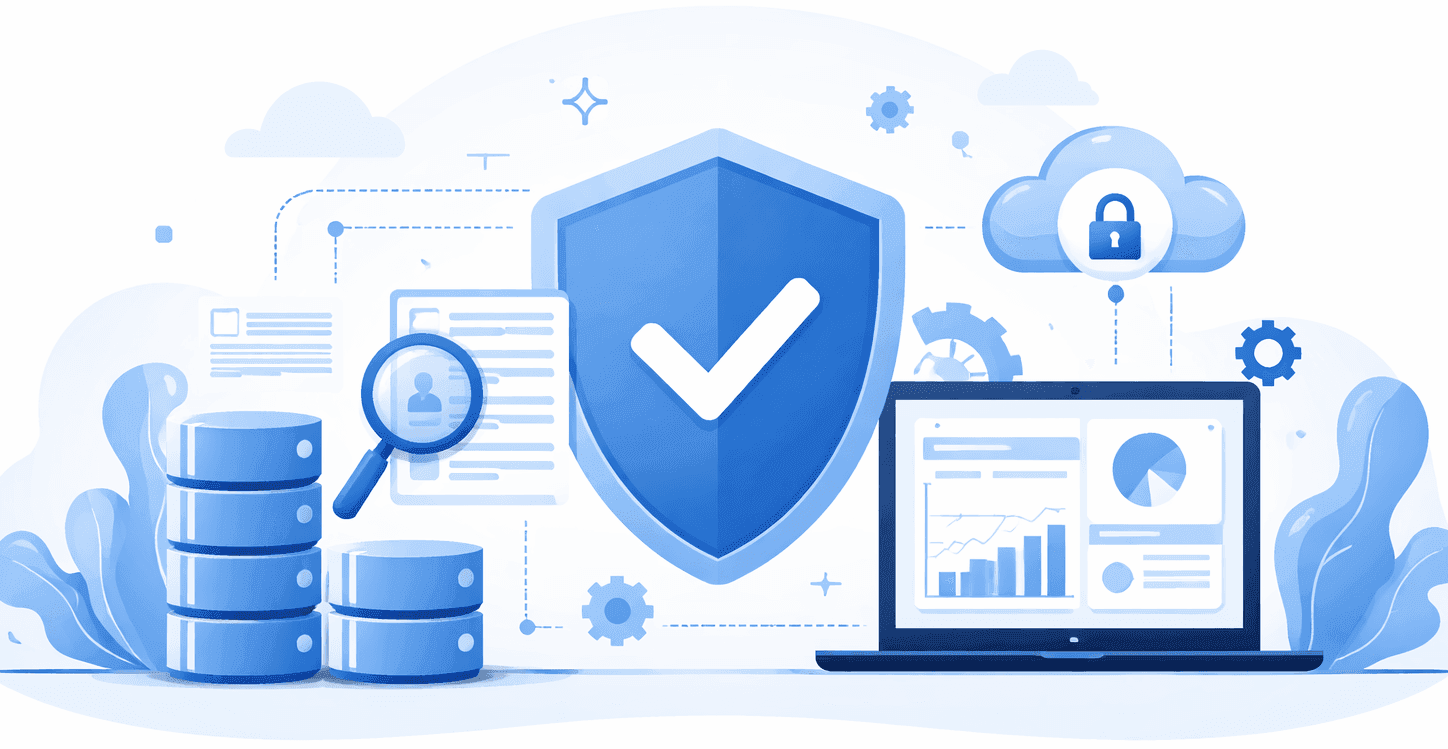
Data has become the backbone of modern business decisions. From understanding customer behaviour to improving operational efficiency, organizations rely heavily on accurate and accessible data. However, as companies collect data from multiple platforms — CRM systems, cloud applications, analytics tools, and customer touchpoints — managing that data becomes increasingly challenging. Many businesses struggle with duplicate records, inconsistent reports, security risks, and regulatory pressure. This is where data governance becomes essential. A well-defined data governance strategy helps organizations maintain data quality, ensure compliance, and build trust in business insights. In this guide, we will explore what data governance is, why it matters, its key components, emerging trends, and best practices for successful implementation. #### What Is Data Governance? Data governance refers to the **policies, processes, roles, and standards** that define how data is collected, stored, managed, and used across an organization. Its primary goal is simple: **Ensure that business data remains accurate, secure, consistent, and accessible.** Effective governance helps organizations answer important questions such as: - Who owns specific datasets? - Who has permission to access or modify them? - Is the data reliable enough for decision-making? - How long should data be retained? - How should sensitive data be protected? When these questions are clearly addressed, data becomes a strategic asset rather than an operational challenge. #### A Simple Example of Data Governance in Action Consider a retail company that stores customer information across different systems — marketing tools, support platforms, and e-commerce databases. Without governance: - Customer names may appear in different formats - Duplicate records may exist - Reports may show conflicting insights With a structured data governance framework, the organization can: - Define standard data formats - Create a single source of truth - Assign ownership for data quality - Implement validation and monitoring processes As a result, teams can confidently use data to improve marketing performance, customer experience, and operational planning. #### Why Data Governance Matters for Businesses **Improves Data Quality** Poor data quality leads to inaccurate reporting and flawed business strategies. Data governance helps ensure: - Standardized formats - Complete and reliable datasets - Reduced duplication - Consistent reporting metrics High-quality data enables organizations to generate meaningful insights. **Enables Better Decision-Making** Executives and analysts depend on trusted data to identify growth opportunities and manage risks. When governance practices are in place, businesses can: - Optimize business operations - Improve customer targeting - Forecast trends more accurately - Increase confidence in analytics outputs **Supports Regulatory Compliance** Modern organizations must comply with strict data protection regulations across industries. A strong governance framework helps: - Maintain audit trails - Protect sensitive information - Meet privacy and compliance requirements - Reduce legal and financial risks **Strengthens Data Security** Data governance defines clear access controls and security policies such as: - Role-based access permissions - Encryption standards - Monitoring and auditing mechanisms - Data masking for confidential records These practices significantly reduce the likelihood of data breaches. **Enables AI and Advanced Analytics** Artificial Intelligence and Machine Learning systems rely on high-quality datasets. Without governed data, analytics models can produce inaccurate or biased results. Data governance ensures: - Clean training data - Transparent data lineage - Reliable analytics outcomes This allows organizations to scale AI initiatives with confidence. #### Key Components of an Effective Data Governance Framework **Data Policies and Standards** Clear policies ensure consistent data handling across departments, including classification rules, privacy guidelines, and retention standards. ##### Data Ownership and Stewardship Defined roles such as data owners, stewards, and custodians help maintain accountability and data quality. **Data Quality Management** Continuous monitoring helps detect errors, inconsistencies, and outdated records before they impact decision-making. **Metadata Management** Well-managed metadata improves data discovery and helps teams understand the context and purpose of datasets. **Data Lineage** Tracking how data moves across systems supports compliance reporting and troubleshooting. **Access Control and Security** Governance frameworks define how users interact with data while maintaining strong security standards. #### Emerging Data Governance Trends in 2026 Modern data environments are evolving rapidly, and governance practices are adapting accordingly. - **AI-driven governance automation** for metadata tagging and anomaly detection - **Governance for responsible AI** focusing on fairness and transparency - **Data mesh adoption** with domain-based data ownership - **Multi-cloud governance strategies** across distributed platforms - **Privacy-first data frameworks** such as anonymization and consent management #### Business Benefits of Implementing Data Governance Organizations that invest in governance typically experience: - Improved trust in analytics - Faster access to reliable data - Reduced compliance risks - Higher operational efficiency - Stronger customer confidence These advantages contribute directly to long-term business growth. #### Best Practices for Implementing Data Governance - Define clear business objectives before launching governance initiatives - Assign ownership for high-value datasets - Start with critical domains such as customer or financial data - Implement a data catalog for improved discovery - Automate data quality monitoring - Build a company-wide culture of data responsibility Successful governance is not only a technical initiative — it is an organizational mindset. #### Conclusion In today’s data-driven economy, data governance is no longer optional. Organizations that manage data effectively can make smarter decisions, improve operational efficiency, and maintain regulatory compliance. As data volumes continue to grow in 2026 and beyond, businesses that prioritize governance will be better positioned to unlock the true value of their data while maintaining security, transparency, and trust.
Read more
Data Management vs Data Governance: Key Differences Explained for 2026
March 26, 2026
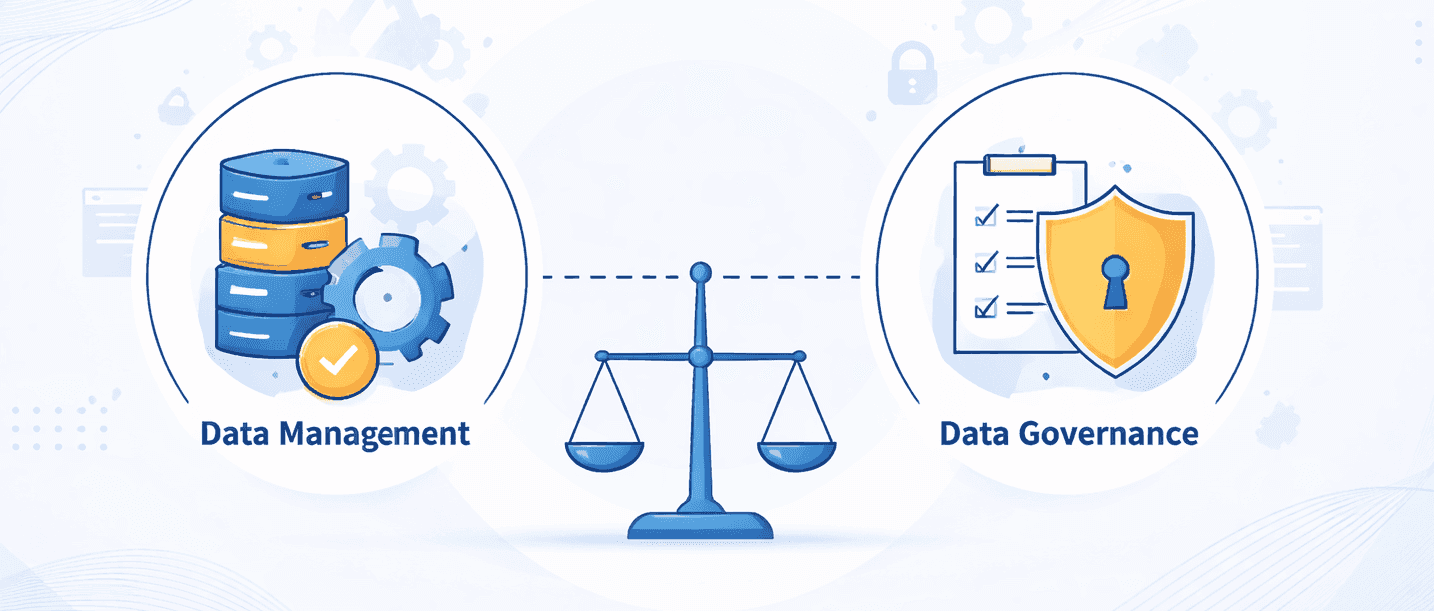
Why Data Strategy Matters More Than Ever In today’s digital economy, businesses run on data. From customer insights and financial reporting to AI-driven decision-making, data has become one of the most valuable assets an organization owns. But simply collecting large volumes of data does not create value. What truly matters is how effectively businesses organize, control, and use that data. This is where data management and data governance play a critical role. Many organizations assume these two terms mean the same thing. In reality, they serve different purposes — yet work together to build a strong and reliable data ecosystem. Understanding the difference between **data governance vs data management** helps organizations: - Improve data quality - Enable reliable analytics - Maintain regulatory compliance - Support AI and digital transformation initiatives In this guide, we’ll explore what each discipline means, how they differ, and why modern businesses need both. #### What is Data Management? Data management refers to the **operational and technical processes** used to collect, store, organize, and maintain data throughout its lifecycle. It focuses on how data moves through systems and how it is prepared for business use. A well-defined data management strategy ensures that information is: - Easily accessible - Stored efficiently - Consistent across systems - Reliable for reporting and analytics #### Key Functions of Data Management Typical data management activities include: - Collecting data from multiple systems - Integrating data across platforms - Transforming and processing datasets - Managing storage in data warehouses or data lakes - Monitoring data quality - Handling data lifecycle stages #### Example: Data Management in Practice Consider an e-commerce business that gathers information from its website, CRM, payment systems, and inventory tools. Strong data management ensures: - All customer and transaction data is centralized - Duplicate records are removed - Sales data aligns with inventory levels - Historical records are archived properly Without effective data management, organizations often face **data silos, inconsistent reports, and unreliable insights.** #### What is Data Governance? While data management focuses on execution, **data governance focuses on control and accountability.** Data governance defines the policies, standards, and responsibilities that determine how data is accessed, protected, and used across the organization. A strong governance framework ensures data remains: - Secure - Accurate - Compliant with regulations - Consistent across departments #### Key Functions of Data Governance Common governance responsibilities include: - Defining data policies and standards - Assigning data ownership and stewardship - Ensuring privacy and regulatory compliance - Setting data quality benchmarks - Managing metadata and data catalogs - Monitoring access and usage #### Example: Data Governance in Practice In a healthcare organization, governance policies may ensure: - Only authorized staff can view patient records - Sensitive data is encrypted - Privacy regulations are followed - Quality standards are consistently maintained Without governance, organizations risk **security breaches, compliance failures, and misuse of sensitive information.** #### Data Management vs Data Governance: What’s the Difference? Although both disciplines deal with enterprise data, their focus areas are different. ![Data Management vs Data Governance](https://stage-blogs.rewardrally.in/gamification-blogs/assets/Data_Management_vs_Data_Governance_2_1efcaf6f61.png) A Simple Way to Understand **Data Governance = The Rules** **Data Management = The Execution** Governance sets expectations, while management ensures those expectations are met within systems. #### How Data Governance and Data Management Work Together These disciplines are not separate initiatives. Instead, they complement each other. **Governance defines:** - Data ownership - Compliance requirements - Quality standards - Security policies **Management implements:** - Data pipelines - Storage infrastructure - Integration processes - Lifecycle management For example, governance may require customer data accuracy to meet a specific threshold. Data management teams then implement validation and cleansing processes to achieve that goal. Together, they create **trustworthy enterprise data.** #### Core Components of Data Governance A successful governance program typically includes: **Data Policies** Clear policies ensure consistency in how data is collected, stored, and shared. **Data Stewardship** Data stewards monitor data accuracy, resolve conflicts, and maintain documentation. **Data Quality Standards** Organizations define measurable benchmarks such as accuracy, completeness, and timeliness. **Compliance and Security** Governance frameworks help businesses meet regulations like GDPR and industry-specific privacy laws. #### Core Components of Data Management Effective data management builds the technical foundation for analytics and operations. **Data Architecture** Defines how data flows through platforms such as data lakes and cloud warehouses. **Data Integration** Combines information from CRM, ERP, and marketing systems to create a unified data view. **Data Storage** Organizations rely on scalable storage technologies including distributed databases and cloud platforms. **Data Lifecycle Management** Data moves through stages like creation, usage, archival, and deletion. **Data Quality Management** Automated tools identify duplicates, missing values, and inconsistencies to maintain reliability. #### Emerging Trends in Data Governance and Management (2026) As organizations become more data-driven, both disciplines continue to evolve. - AI governance for training data transparency and bias mitigation - Stricter privacy regulations and consent management requirements - Data mesh adoption with decentralized ownership models - Metadata-driven strategies for discovery and lineage tracking - Automated governance platforms powered by AI #### Business Benefits of Strong Data Governance and Management Organizations that invest in both areas gain significant competitive advantages. - Faster and more accurate decision-making - Reduced compliance and legal risks - Higher data quality and consistency - Improved analytics and AI performance - Stronger organizational trust in data When teams trust their data, innovation and agility naturally increase. #### Best Practices for Implementation To build a successful enterprise data strategy: - Start with clear business objectives - Establish a formal governance framework - Invest in modern cloud-based data architecture - Implement data catalogs and metadata management - Automate quality monitoring processes - Promote a data-driven culture across teams Treat governance and management as two parts of one strategy, not separate initiatives. #### Final Thoughts Understanding the difference between data management and data governance is essential for organizations aiming to become truly data-driven. Governance defines the rules and accountability. Management ensures data is processed, stored, and delivered effectively. Together, they create a structured, secure, and scalable data ecosystem that supports analytics, AI innovation, compliance, and long-term business growth. As data volumes continue to grow in 2026 and beyond, companies that invest in both governance frameworks and robust data management practices will be best positioned to unlock real business value.
Read more
Governance Strategy & Policy Design: A Practical Framework for Scalable Data Control
April 7, 2026
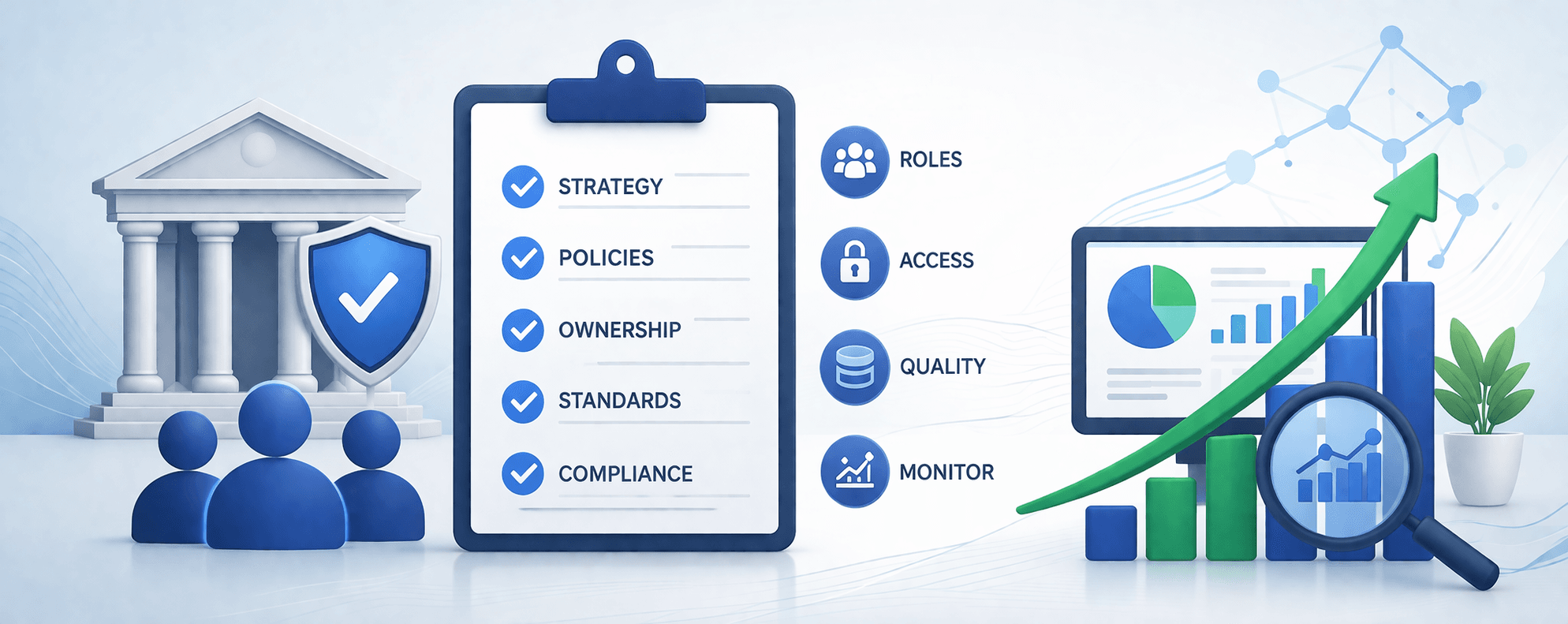
Every growing business reaches a point where data chaos starts slowing decisions, compliance risks increase, and teams lose trust in reports. That’s where **governance strategy & policy design** becomes a business-critical capability. A well-defined governance model helps organizations create clear ownership, improve data quality, enforce security, and align policies with business goals. Modern governance frameworks now focus on agility, accountability, metadata, access control, and AI readiness. Industry best practices consistently emphasize **roles, standards, KPIs, compliance, and business alignment** as the foundation of strong governance. In this guide, you’ll learn how to design an effective governance strategy, create scalable policies, and implement a framework that supports long-term growth. #### What Is Governance Strategy & Policy Design? Governance strategy & policy design is the structured process of defining how data, systems, processes, and business rules are managed across an organization. It includes: - Governance vision and objectives - Policy creation and enforcement - Data ownership and stewardship - Security and access rules - Compliance controls - Metadata and business glossary standards - Monitoring KPIs - Review and continuous improvement The goal is simple: **make data trustworthy, secure, accessible, and business-aligned.** #### Why Governance Strategy Matters for Modern Enterprises A strong governance strategy supports: **1) Better Data Quality** Clear policies reduce duplication, inconsistency, and outdated records. **2) Faster Decision-Making** Teams can confidently use governed data for analytics and AI initiatives. **3) Regulatory Compliance** Policies help meet **GDPR, HIPAA, CCPA, and industry-specific standards.** **4) Stronger Security** Role-based access and classification policies reduce exposure risks. **5) Cross-Functional Alignment** Marketing, finance, HR, and IT all follow one trusted governance model. Best-practice frameworks highlight **ownership, accountability, compliance, adaptability, and KPIs** as the pillars of effective governance. #### Governance Strategy & Policy Design Framework A practical governance framework should include the following layers. **1. Business Goals and Governance Vision** Start by aligning governance with measurable outcomes: - Improve reporting accuracy - Reduce compliance violations - Enable AI readiness - Standardize customer data - Strengthen data catalog adoption **Pro Tip:** Governance should support **revenue, risk reduction, and efficiency—not just compliance.** **2. Roles, Ownership, and Accountability** Define who owns what. Key roles include: - Chief Data Officer (CDO) – executive governance leadership - Data Owners – business accountability - Data Stewards – quality and metadata control - Security Teams – access and privacy enforcement - IT Teams – systems integration and implementation Without clear ownership, policy design usually fails. **3. Policy Design Standards** Your governance policies should cover: - Data classification - Naming conventions - Metadata standards - Retention policies - Access control - Privacy requirements - Quality rules - Lineage documentation - Incident escalation workflows **Example Policy Statement** **Customer PII can only be accessed by approved finance, compliance, and support users through role-based permissions.** This makes enforcement measurable and auditable. #### Best Practices for Governance Policy Design Here are proven strategies used by modern enterprises. **Start Small, Scale Fast** Begin with one high-impact domain: - Customer data - Finance reporting - Product analytics - Compliance-sensitive records **Use Business Glossaries** Standard definitions reduce metric conflicts across teams. **Build Policy Lifecycle Reviews** Policies must evolve with: - New regulations - New systems - Mergers - AI tools - Data products **Define Governance KPIs** Track measurable outcomes such as: - Data accuracy % - Policy adherence % - Access violation incidents - Metadata completeness - Data discovery time - Audit readiness score KPIs are repeatedly recommended as a **core governance success factor.** #### Practical Use Cases of Governance Strategy & Policy Design **Enterprise Data Governance** Create standards for master data, metadata, lineage, and access. **AI Governance Readiness** Define ethical AI usage, training data quality, explainability, and compliance rules. **Financial Reporting Governance** Ensure clean reconciled data for quarterly and annual reporting. **Customer 360 Governance** Unify customer identity rules across CRM, support, loyalty, and analytics systems. #### Common Challenges in Governance Design Many organizations struggle with: - Lack of executive buy-in - Poor role clarity - Overly complex policies - No ownership model - Manual governance workflows - Low adoption by business teams **How to Fix It** - Use simple business-first language - Automate policy checks - Build stewardship workflows - Integrate with data catalogs - Review policies quarterly - Train teams continuously #### Tools That Strengthen Governance Policy Execution Modern governance strategy works best with: - Data catalogs - Metadata management platforms - Data lineage tools - Access governance tools - Quality monitoring systems - Policy workflow automation - Compliance dashboards These tools improve **discoverability, stewardship, and enforcement at scale.** #### Conclusion A strong **governance strategy & policy design framework** is no longer optional—it is essential for compliance, AI readiness, trusted analytics, and business scalability. The most successful organizations treat governance as a **living operating model, not a one-time documentation exercise.** By combining clear ownership, measurable KPIs, adaptable policies, and the right governance tools, businesses can create a resilient foundation for data-driven growth. If your organization is planning a **data governance consulting initiative, policy modernization, or AI governance framework**, now is the right time to start with a scalable strategy.
Read more
Metadata Management & Data Cataloging: The Foundation of Trusted Data
April 13, 2026
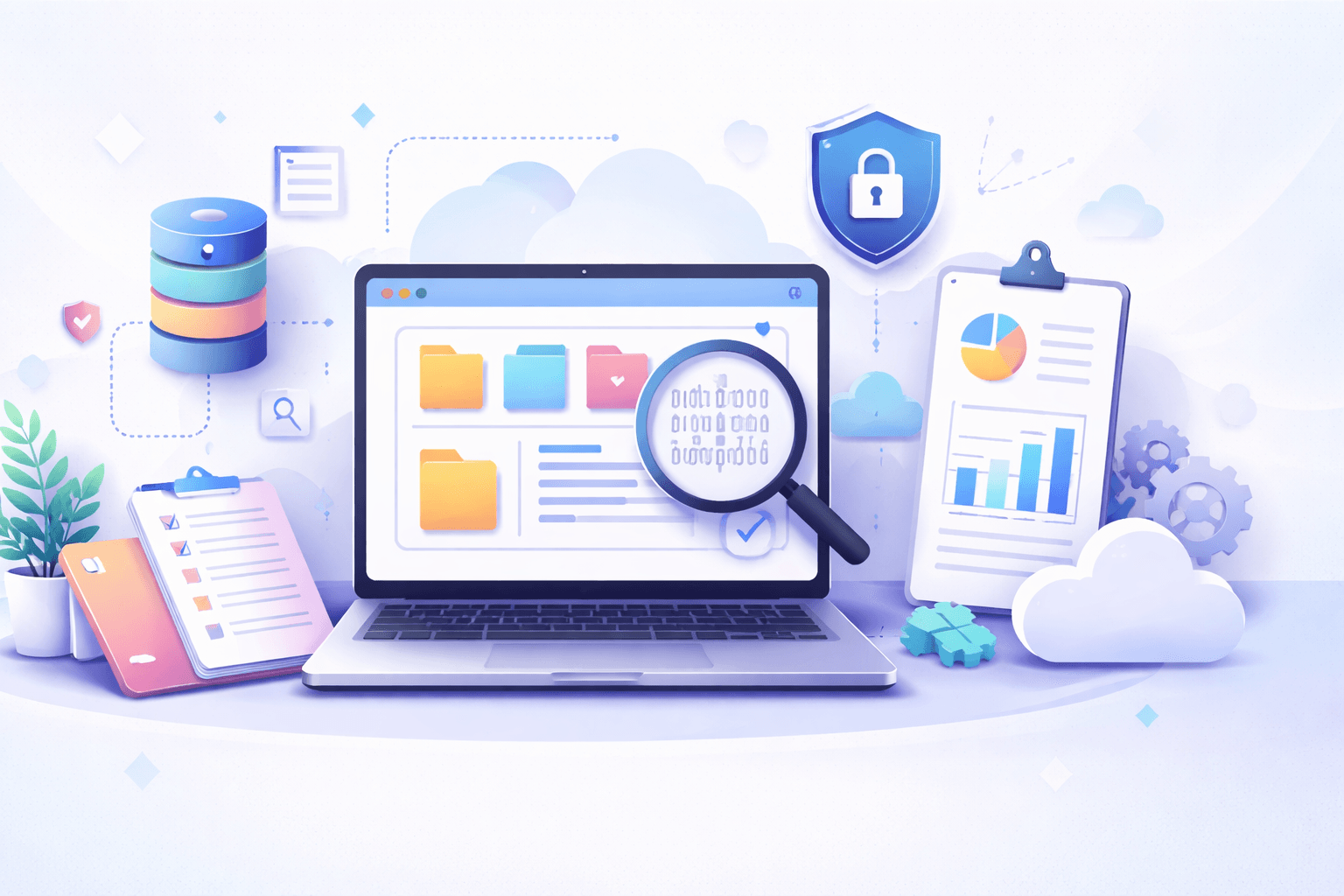
Your data is only as valuable as your ability to find, trust, and use it quickly. Many organizations have massive volumes of data, but teams still struggle to locate the right dataset, understand ownership, or verify definitions. This is where metadata management & data cataloging become essential. They create a searchable, governed, and trusted layer over your data ecosystem, helping business and technical users discover the right data faster. Modern enterprises rely on metadata, data lineage, business glossaries, and governance workflows to reduce confusion, improve compliance, and speed up decision-making. --- ## What Is Metadata Management & Data Cataloging? Metadata management is the process of organizing, governing, and maintaining information *about data*-such as schema, definitions, lineage, ownership, sensitivity, and quality. A data catalog is the user-facing layer that makes this metadata searchable and easy to explore. Think of it like this: **Metadata = the context** **Data catalog = the searchable library** **Together = trusted data discovery** ### Key Components - Business glossary - Data lineage - Data ownership - Data classifications - Usage analytics - Policy tags - Search and discovery - Certification workflows These components work together to build a single source of truth for enterprise data. ## Why Metadata Management & Data Cataloging Matter ### 1) Faster Data Discovery Analysts often waste hours searching for the right tables, dashboards, or reports. A metadata-powered catalog enables: - Natural language search - Domain-based filtering - Semantic recommendations - Owner-based discovery - Related asset suggestions This dramatically reduces time-to-insight. ### 2) Better Data Governance Governance becomes practical when metadata includes: - Sensitivity labels - PII flags - Retention rules - Steward ownership - Access policies This supports compliance initiatives like: - GDPR - HIPAA - SOC 2 - Internal audit controls ### 3) Improved Data Trust When users see: - lineage - freshness timestamp - certified badges - source system - owner details they trust the data faster. --- ## Best Practices for Metadata Management & Data Cataloging ### Automate Metadata Ingestion Avoid manual spreadsheet-based documentation. Use automated connectors for: - Snowflake - BigQuery - Redshift - Power BI - Tableau - dbt - ETL tools - APIs Automation keeps metadata fresh and reduces catalog decay. ### Standardize Business Definitions Different teams often define the same KPI differently. For example: - Sales: customer = won deal - Finance: customer = invoiced account - Product: customer = active login A business glossary solves this by creating shared definitions. ### Enable End-to-End Data Lineage Lineage helps answer: - Where did this metric come from? - Which dashboard depends on this table? - What breaks if schema changes? This is critical for: - root cause analysis - impact assessment - audit readiness - faster debugging ### Add Stewardship Workflows Assign clear ownership for: - datasets - glossary terms - KPIs - pipelines - compliance tags Ownership improves accountability and catalog adoption. ## Practical Use Cases of Metadata Management & Data Cataloging ### Enterprise Analytics Teams Helps analysts quickly locate: - trusted sales datasets - customer churn dashboards - finance KPI reports - campaign attribution models ### Regulatory Compliance Supports: - sensitive data discovery - lineage traceability - access audits - policy enforcement ### AI and ML Readiness AI initiatives fail when teams cannot trust feature data. Metadata helps with: - feature lineage - source validation - dataset quality checks - reuse of governed assets ### Self-Service BI Business users can independently find: - approved dashboards - certified metrics - reusable reports - data definitions This reduces dependency on engineering teams. ## Practical Tips to Build a High-Adoption Data Catalog - Start with high-value domains first - Prioritize finance, customer, and revenue data - Add business-friendly descriptions - Use tags and glossary terms - Track search behavior - Show popularity signals - Certify gold-standard datasets - Continuously monitor stale assets **Pro tip:** adoption improves when the catalog feels like a business discovery platform, not just a technical metadata repository. ## Conclusion In today’s data-driven environment, metadata management & data cataloging are no longer optional - they are essential for trust, speed, governance, and scalability. When metadata is automated, standardized, and surfaced through an intuitive catalog, teams gain: - faster discovery - better governance - stronger compliance - improved collaboration - trusted analytics The real business value comes when data becomes easy to find, easy to trust, and easy to use. If your organization wants to improve data visibility, governance, and decision-making, now is the time to invest in a metadata-first cataloging strategy. **Want to improve your data governance framework? Start by auditing your current metadata maturity and identify the highest-value domains for cataloging first.**
Read more